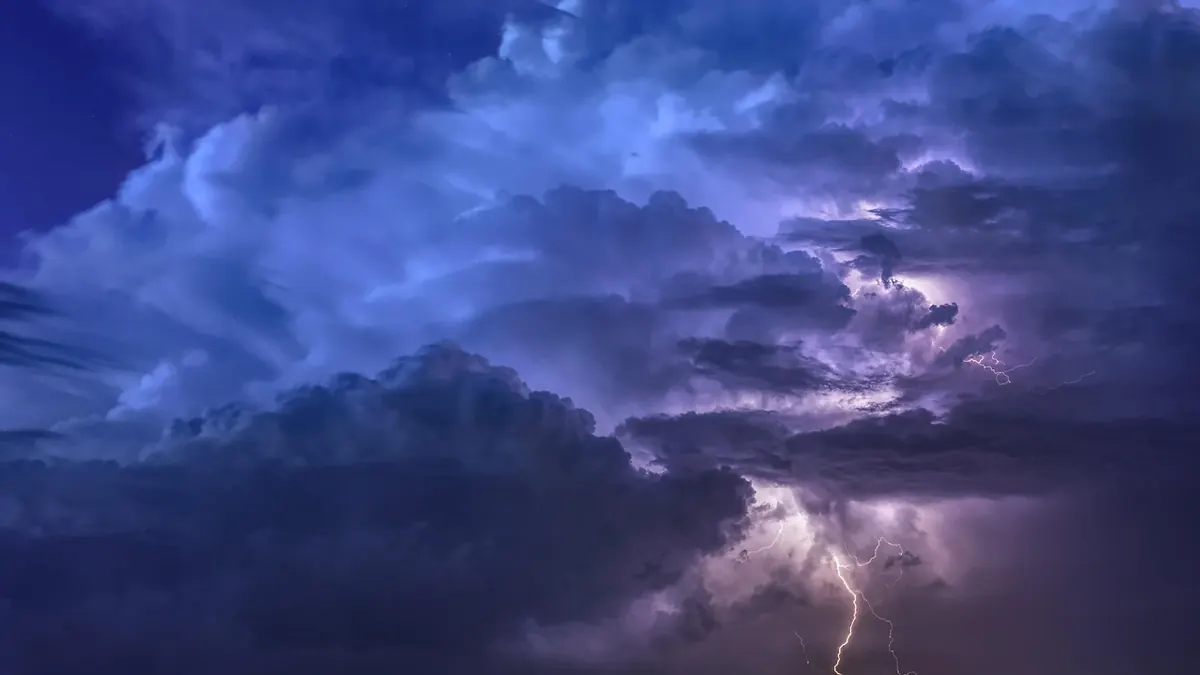
A good lightning photograph is mostly a test of patience and positioning. The bolts are generous; the risk is not. Every British summer brings a handful of thunderstorms worth chasing, and every year people end up in hospital for standing in the wrong place holding a tripod. The trick is to set up so that shelter and camera occupy the same spot. Get that right and you can shoot for hours, dry and unhurried, while the storm does the work.
Shelter first, camera second
If you can hear thunder, you are close enough to be at risk from the next strike. The familiar flash-to-bang guideline is worth keeping in your head: count the seconds between the flash and the thunder. Thirty seconds or less means the storm is roughly within ten kilometres, so stop what you are doing and get inside. Then stay inside for a full thirty minutes after the last rumble. Storms throw out trailing strikes well behind the main rain band.
A substantial building or a hard-topped car with the windows up is shelter. A tree, a bus shelter, a bandstand, a tent, a golf umbrella or a fishing bivvy is not — they offer rain cover and nothing else. Neither is standing beside a fence, a pylon, a canal or a lake, or being the tallest object on a ridge.
If you are caught in the open with no way out, crouch low on the balls of your feet with your feet together and your head down, hands off the ground. That is damage limitation, not a plan. Build your evening around avoiding it.
Read the storm before you leave the house
British thunderstorms are usually short-lived and often embedded in larger areas of rain, which makes them harder to chase than the great plains variety. Radar and lightning-detection apps on a phone will show you where the active cells are, which way they are tracking and how long you have before the rain arrives. Met Office warnings are useful for judging whether the day is worth the trip at all.
Two patterns are worth knowing. Afternoon and evening storms in summer often build along a convergence line and drift north-east, giving you twenty minutes of drama before they weaken. Elevated night storms are different: the lightning is mostly cloud-to-cloud, so you get long, pulsing sheets of light and far fewer bolts to ground. They are excellent for long exposures and much easier to shoot from a fixed position.
The best window is often the back edge of the rain. The cloud base lifts, visibility improves and the strikes are still coming — so plan to be in position before the rain clears rather than after.
Camera settings that actually work
Everything manual, including focus. The camera has no idea what a lightning bolt is, and autofocus will hunt in the dark exactly when you need it to be still. Switch to manual focus, zoom into a distant streetlight or bright star in live view, focus, then tape the ring so it cannot drift. Turn image stabilisation off on a tripod.
After dark
- Mode: manual, or bulb with a remote release
- ISO: 100–200, as low as you can go
- Aperture: f/8 to f/11 for a balance of sharpness and depth
- Shutter: 10–30 seconds, extended in bulb if the storm is slow
- Format: raw, so you can tame the sky later
Set your first frame for the ambient light rather than the bolt. A strike is far brighter than anything else in the scene, and an exposure that looks gloomy on the back of the camera is usually about right. Long-exposure noise reduction doubles the wait between frames, so leave it off and clean up hot pixels in editing unless you are shooting a single hero frame.
In daylight
Daytime strikes are much harder because there is simply too much light for a long shutter. Options are a strong neutral density filter, a small aperture such as f/16 with a low ISO, or shooting video at a high frame rate and pulling a still from the frames. Video is often the pragmatic choice during a fast-moving afternoon storm.
Timing and trigger discipline
Lightning arrives in bursts. The first bolt is rarely the only one, so once the sky starts flashing, keep shooting without reviewing images between frames. Re-cock the shutter, glance at the sky, fire again. On a tripod with a remote release you can hold the shutter open through a whole cluster of flashes and let them accumulate on a single frame.
Watch the sky rather than the screen. The flash you see out of the corner of your eye is your cue, and if the thunder follows almost immediately you should be closing a window, not reaching for a cable. Set the camera up before the storm is overhead, not during it.
Kit, comfort and keeping the lens dry
Rain is the constant companion of British lightning, so treat waterproofing as part of the setup. A rain cover or a shower cap over the lens, a microfibre cloth in a zip pocket and a spare battery kept warm inside a jacket will get you through an evening. Weight the tripod by hanging your bag from the hook, and keep a small torch to hand for changing settings.
Shooting from a car is the most practical option for most people. Through closed glass you lose a little contrast, but you keep your fingers and you can move quickly when the cell shifts. If you open the window, keep your hands and arms well clear of the metal frame. Condensation is the other nuisance: a camera that has sat in a warm car will fog the moment you take it outside, so let it acclimatise in a bag and give the front element a wipe before you start.
Framing the strike
Composition matters more than you might expect, because the bolt lands where it likes. Choose a fixed frame with a strong horizon, a foreground that gives the sky some scale — a line of trees, a church tower, a lit road — and no competing streetlights. Then leave the camera where it is. A stable frame lets you combine separate strikes from the same view later on, which is how most dramatic multi-bolt images are actually made. Keep the editing restrained; over-brightened skies look like bad weather on television.
A simple routine for the next storm
- Check warnings and radar in the afternoon and pick a location with real shelter, ideally a car you can sit in.
- Arrive in daylight, work out which direction the storm will approach from and where the rain will come from.
- Set up under cover: tripod down, manual focus at infinity, test frame checked at 100 per cent.
- Shoot in bursts through each cluster of flashes, and keep one eye on the sky throughout.
- Wait a full thirty minutes after the last thunder before you step back out to pack up.
- Dry everything, back up the cards, then edit with a light touch.
The photograph you want will come from a storm you watched from somewhere safe, with the camera already pointed at the right piece of sky. If someone near you is struck, call 999 immediately — it is safe to touch and help them, as a lightning casualty carries no charge. Otherwise, the sensible rule is the dull one: no picture is worth standing under a tree in the rain.
Photo: Felix-Mittermeier / Pixabay